Cooling is a major consideration with this engine, after a tour of a local breakers it looks like a Rover 100 radiator will fit nicely at the front as shown below:
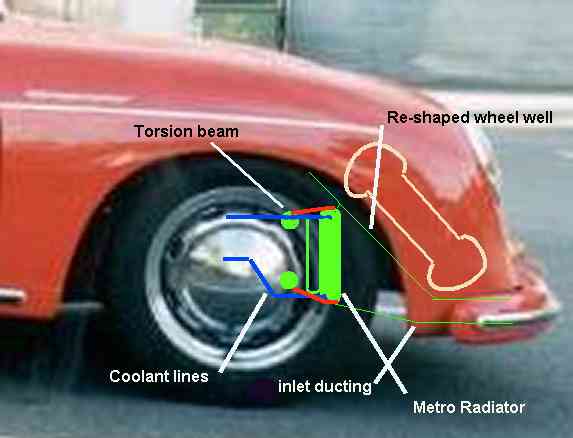
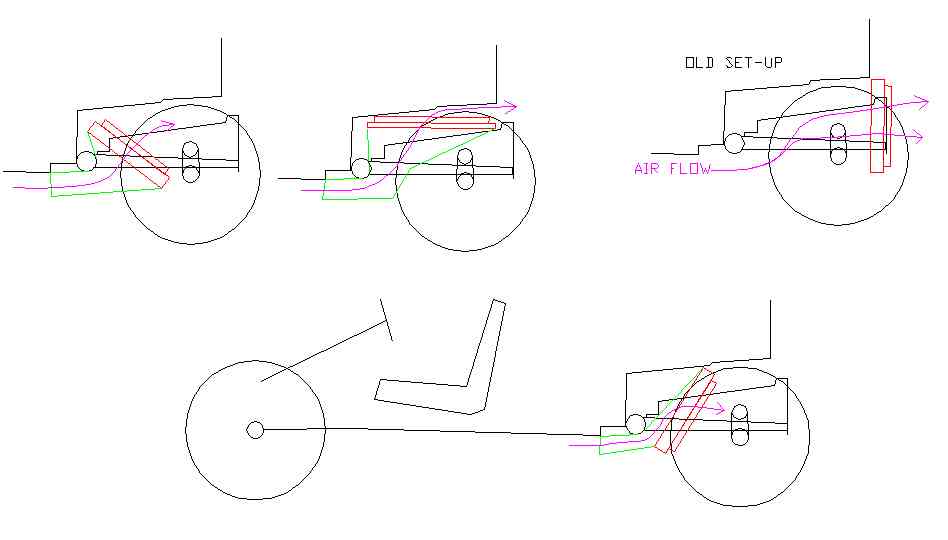
I will probably add another one at the rear on the right side of the car as in the same position the mini rads were. I can only fit one as the turbo is in the way on the other side. I was reluctant to fit the rad up front after my problems with the original Alfa setup for a few reasons. The first was that air wasn't escaping properly out of the enclosed spare wheel well, the second being that I desperately wanted to keep my spare wheel.
To allow the fitting of a radiator in this position I will have to remove the anti-roll bar, as I have removed the torsion leaves for the coil-over suspension, I am now going to refit the leaves but without locating them at the centre, this will then turn them into an anti-roll bar!
I've finalised how all the cooling is going to fit in now and have a few pictures of the progress so far:
|
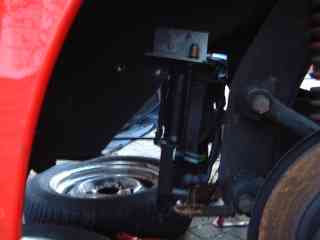
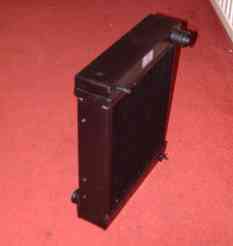
I bought a new Metro 2 radiator which fits nicely in the front, here you can see the cut which I will fill with Aluminium sheet to form the top of an enclosed scoop. I'll put the rest of the scoop underneath when the lines are connected up. |
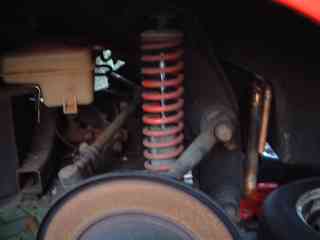
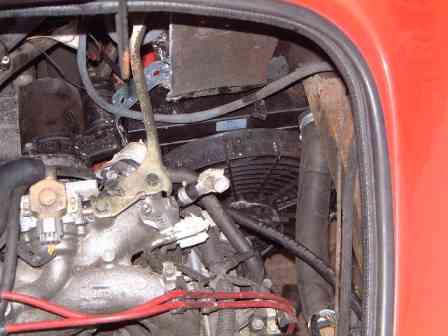
Here's the other side, the top mountings are mounted on rubber bushings to insulate the radiator from vibrations, I have kept the original fan which pokes backwards slightly but still fits between the torsion bars. I'll fit some simple horizontal straps to locate the bottom of the rad. |
|
I made up a soldered rigid pipe for the inlet side of the rad, this includes a bleed pipe at the top (there wasn't a bleed pipe on the radiator) and I've also fitted the Metro expansion bottle. I'm going to connect up the smaller bore pipe on the bottle to the high points of both the rigid lines to completely eliminate the possibility of getting air trapped in the system. The expansion bottle doesn't have a pressure blow off facility in the cap so the system still depends on the rear subaru cap. |
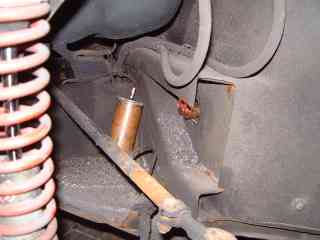
The pipes exit the interior here and then go down to either side of the rad, making them high points at the front, that's why they are both connected to the front expansion bottle. |
|
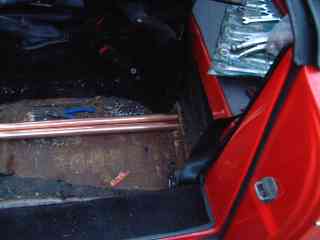
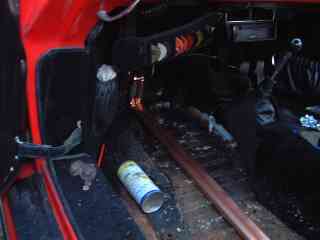
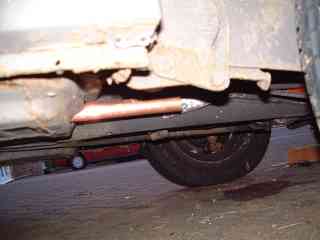
The rigid lines fit nicely along the floor, I'll cut a channel out of the false floors and then insulate them to protect them. |
 |
|
The lines exit nicely high up at the back of the floor, I'll continue the pipe run from here. |
I had this radiator made up from a 4 row mini core with bigger pipe fittings by Readyrads in Birmingham. |
|
Rear view of the custom radiator installed |
Side view of rear radiator with fan installed |
|
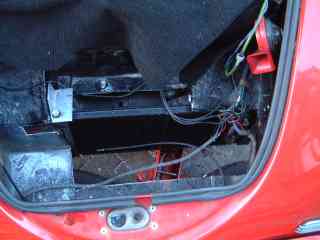
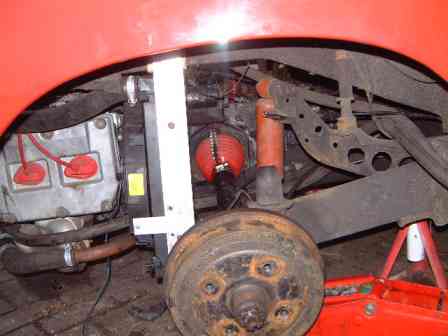
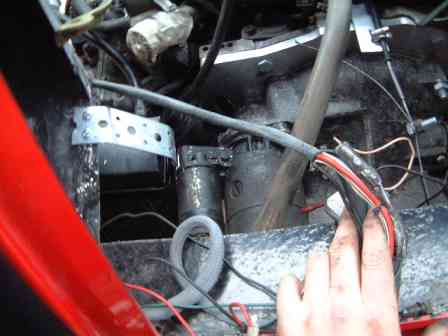
Clearance between the radiator and starter motor is very close. In fact, I had to remount it after I got the starter motor fitted. I also had to be careful of clearance between the inside of the rear tyre. |
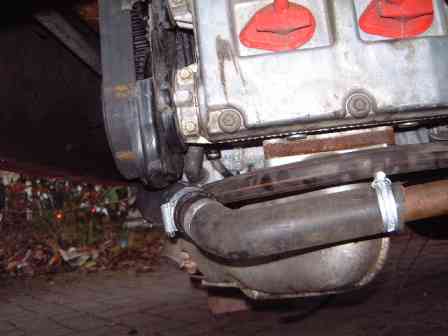
The pipe for the heater return was rigid and in the way of the radiator, so I cut it and missed out the rigid pipe entirely, connecting straight to the engine block. DON'T DO THIS! I didn't see a small bore pipe which was connected to this rigid pipe that formed part of the coolant bypass circuit, the first time the thermostat opened the water gushed out! |
Latest developments:
I wanted to have the engine fitment as standard as possible but, due to the extra length of the coolant hoses in the heater circuit and the restriction of the heater matrix, it was necessary to put a bypass in to the heater circuit. I made it out of 3 copper Ts and also added a bleed point in the centre of it. This allows more coolant to flow in the bypass circuit and thus the thermostat. The problem I was having before was that the thermostat wasn't opening until quite high temperatures as it was isolated to the main engine coolant temperatures. Adding the T helped it get more flow and it all works fine now. Although I think I may need a larger expansion tank as the volume is too low until the whole circuit has got warm which results in similar problems to before. Although it is easily overcome by revving the engine a bit and the extra flow opens up the thermostat.
Phase 2!
I wasn't completely happy with the above system as the flow wasn't that efficient at passing through the radiator core and I wasn't sure of it's ability to cope with warmer climates. With my forthcoming trip around Europe this was a major consideration. On the shoptalk forums somebody reported good success with an Alfa 33 radiator, I got one of these from Gareth Mayers (he is building an Alfa powered speedster but with twin mini rads like my old set-up).
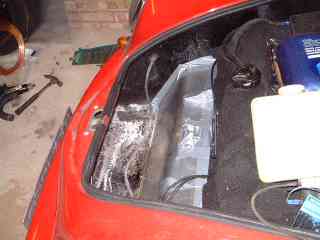
So, I got the saw out again and started cutting up the spare wheel well again! The Alfa radiator has a convenient 'eye' for mounting at the top of it and is a nice size to fit in front of the torsion beam, being about the same height and width, the inlet is a bit close to the steering box but it'll do. I moved the fan over to the middle so it didn't interfere with the mounting of the framehead. The front expansion bottle was deleted and I added another small bore copper pipe in the false floor which goes up to the expansion tank at the back.
|
Here is the radiator fitted before I made any of the ducting. |
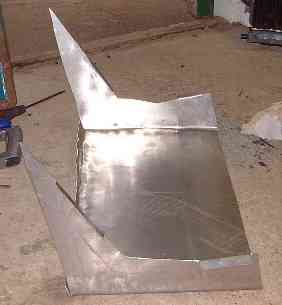
I used cardboard to make a template and then cut this scoop out in one piece of sheet aluminium. |
|
Simple sheet makes up the top of the ducting. The duck tape is just to ensure I don't get leaks but will probably be replaced by a rubber seal. |
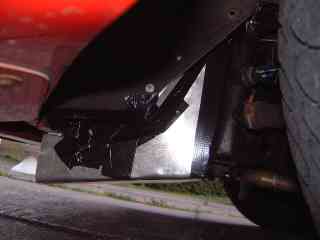
Scoop in place, I slightly miscalculated the shape of the sides (made the template at a different point). You can also make out the radiator fan switch and the return pipe. |
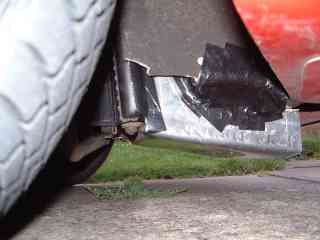 |
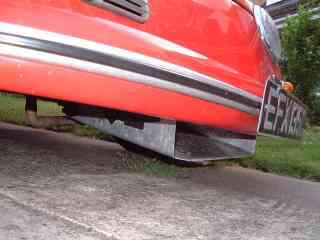
It is 2 1/2 inches high, which doesn't help ground clearance, but I want it to be as effective as possible |
|
The scoop isn't actually that noticeable from a normal viewing position |
Not cooling related, but I just painted the exhaust manifold with matt black exhaust paint over the standard silver galvanized finish, the engine is a lot less conspicuous now... |
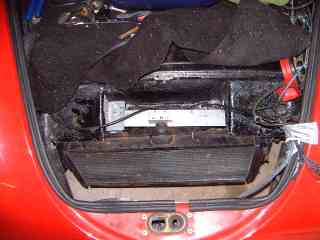
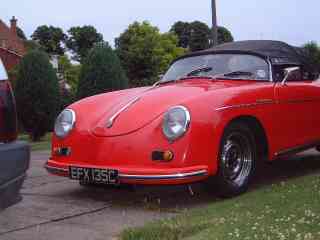
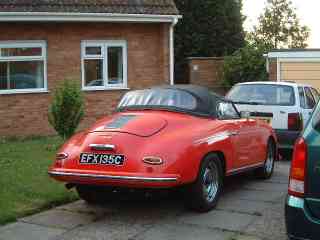
So, the burning question, does it work?
Well, so far it has been working perfectly, the front radiator gets plenty of natural air flow (I can feel warm air coming up through the handbrake gaiter!) and the extra capacity of the rear radiator and fan will help in hot weather traffic. It hasn't been very warm for the last few days, but I was cruising at an average 85mph and the temperature gauge refused to move off the thermostat setting (approx 82 degrees)Just having the single expansion tank is much better. Before, I was getting a minor coolant loss every time I stopped the engine, this was due to the pressure drop between the hot and cold lines but now they are all equalized with the single expansion tank, the larger radiator probably helps too.
Oh, and I can still fit my spare wheel in!